
The Anatomy of a Ghost: How Grief Lives in the Body and What It Needs to Release

“The body holds what the mind tries to move past.”
TL;DR – The Heart of It:
Grief is a physical experience stored in the nervous system and tissues long after the mind has tried to move on.
Some losses never get a ceremony. Estrangement; severed ties; a future that never came to be. These carry their own distinct somatic weight.
Healing is about giving the body enough safety and containment to finally complete what the loss never let it finish.
It started with a message.
Words on a screen, from someone I had not heard from in years. Someone tied to a version of my life I thought I had quietly folded away. Before I could even finish reading, something in my chest shifted. There was a tightening just below the sternum, a breath that stopped halfway, a heaviness that felt oddly familiar, like a room I had been away from for a long time but still somehow knew by heart.
That’s the thing about grief. By the time your mind catches up, the body has already responded. It never forgot. It was holding everything all along.
We tend to think of grief as something that visits us then eventually leaves. We wait for it to pass and give it a timeline. It’s similar to how we treat the weather. But grief is not a storm just moving through. For many of us, it is more like a continuous resident. Something that takes up space in the tissues, our posture and in the nervous system's baseline hum, long before we had language for what we lost.
This is what I have come to understand through my own life and through the work I do at Veluna Wellness. The body archives loss in ways the mind simply cannot access. It is why somatic bodywork exists—to reach what talk alone cannot.
It is what the body does with what it could not keep.
What the Body Holds and What It Holds It For
Most people who are grieving do not look like they are grieving. They function and show up. From the outside, everything appears intact. But on the inside, the nervous system is quietly keeping score.
Unprocessed grief has a physical texture. It lives in the breath that never fully drops into the belly. The chest stays slightly collapsed even on good days and in the jaw, which may only unclench during sleep. The body does not separate emotional experience from physical experience. Every loss that was never fully metabolized leaves a residue. And that residue slowly, imperceptibly shapes posture, baseline tension, and the way we inhabit our own skin. Long after the acute pain has quieted, the body is still holding the weight of what the mind tried to move past.
Research in somatic psychology has pointed to this for decades. Dr. Bessel van der Kolk's work, most widely known through "The Body Keeps the Score," established what many body-based practitioners had long observed: that unresolved emotional experience is stored somatically. The nervous system encodes what the psyche cannot yet integrate. Grief is no exception.
Not all grief arrives with ceremony or social recognition. Some losses have no funeral, ritual or collective acknowledgment that something real has ended. This is where the grief of estrangement lives. Similar can be said about mourning a future that was imagined in detail but never came to be. The life that felt within reach until, quietly, it wasn't. Therapist Pauline Boss coined the term "ambiguous loss" to describe grief that exists without external validation. Unlike death, it comes without a defined moment of ending and social permission to mourn. There isn’t a script for it, a shared language or an acknowledgment that something real has been lost. The grief is entirely real and entirely private.
What I think of as "kinless" grief carries a particular kind of weight within this. When there is no ancestral safety net to return to, no family holding the same memories or sharing the same wound, the body absorbs a burden it was never meant to carry in isolation. The grief becomes layered. It’s about what was lost and the absence of anyone to lose it with.
Shapeless grief is the hardest to locate precisely because it has no defined edges. Named grief has somewhere to go. This kind tends to settle everywhere, which is why the more useful question is rarely "why am I still sad?" but more like, "where am I actually carrying this?".
Why Doesn't It Just Go Away?
At some point, most grieving people ask themselves this. Months pass, sometimes years and the loss is still there: present and capable of surfacing without warning in the middle of an ordinary Tuesday. The assumption we carry is that time is supposed to fix this and that grief has an arc with a natural endpoint. A belief that if we’re still feeling it, something has gone wrong.
But nothing has gone wrong.
Grief does not move through us in a straight line because it was never designed to. It is less like a season that changes and more like a shift in the architecture of who you are. What you lose doesn’t just leave a gap; it reorganizes things. The nervous system in particular, holds the shape of it long after the conscious mind has tried to move forward.
From a physiological standpoint, this makes sense. When we experience loss, the body initiates a stress response. In cases where the loss is sudden, ambiguous or unresolved, that stress response can remain open indefinitely. The body stays in a low-grade state of alert, waiting for a closure that never arrives. This shows up as chronic tension in the shoulders or jaw, a flattened emotional range, or a pervasive sense of bracing that becomes so familiar it starts to feel like personality. Somatic therapist Peter Levine, whose work on trauma and the nervous system has been foundational in trauma-informed body-based healing, describes this as incomplete biological responses. The body began something it was never allowed to finish.
This is where the ghost metaphor feels most true to me.
The ghost is not a haunting in the dramatic sense. It is the somatic imprint of something that mattered enough to leave a mark. What the body holds, it holds because it loved it and lost it before it was ready. There was no safe container in which to fully feel the weight of what happened. The body is not being dramatic but it is being loyal.
When grief doesn’t anywhere to land, it finds its own places. It settles into tension, numbness and that specific ache, which follows you into moments that should feel light, but somehow don’t. It speaks the only language available to it—the language of the body.
This is why the goal was never to move on. It was always to learn to move with it.
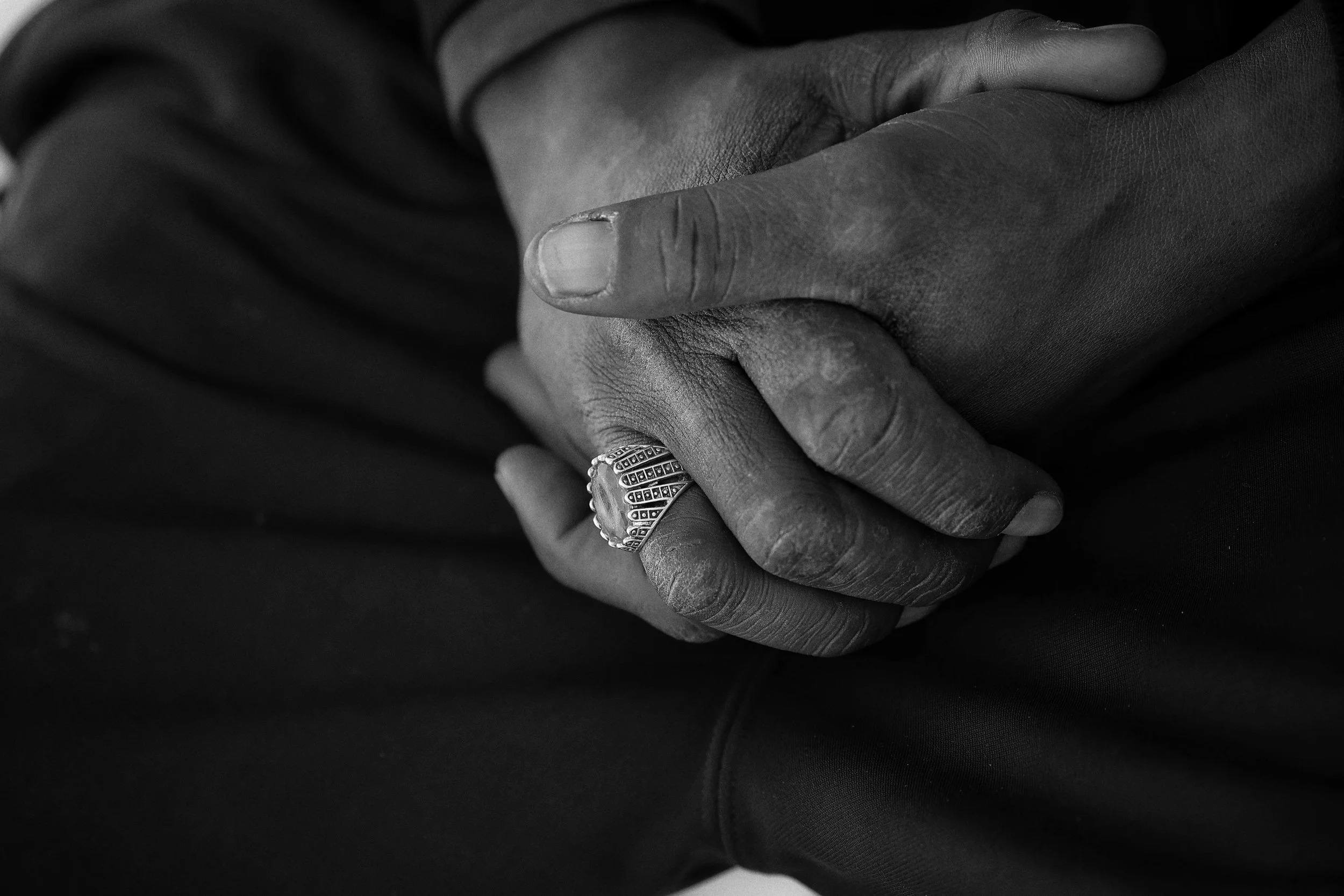
“The body began something it was never allowed to finish.”
What Integration Actually Means
Integration is one of those words that gets used a lot in wellness spaces without much explanation of what it actually feels like in practice. It tends to get conflated with processing, which implies something intellectual; something you think your way through. It also gets confused with moving on, which implies erasure, clean break or loss finally behind you. Integration is something else entirely.
What integration actually means is closer to this: the grief gets a place to live that is not your jaw, your chest, your sleep, or your capacity to be present in your own life. It means the body is no longer spending its energy managing something that has never been acknowledged. The relationship to carrying loss changes. It doesn’t disappear.
There is an important distinction worth sitting with here. Processing grief cognitively has genuine value. But understanding something and integrating it are not the same movement. You can have complete intellectual clarity about a loss and still feel it lodged somewhere beneath the ribcage every single morning. That is the body telling you that insight alone was never going to be enough.
This is where the idea of the body as an altar becomes meaningful to me. A site of meeting, as in what has been lost and what remains can finally occupy the same space. Ritual in this sense, is about creating the conditions for the nervous system to do what it was always capable of doing, given enough safety and enough time.
The honest truth is that there is no cure for grief. There is no endpoint where you cross over into a version of yourself that is fully unburdened. What changes through real integration work is the body's relationship to the weight. It becomes something you carry with more ease. The question shifts from "how do I get rid of this?" to something quieter and more useful: where in my body is this actually living?
The Sanctuary of Ritual: Bringing the Ghost Into the Room
At Veluna Wellness, ritual is physiological. It is what happens when the body is finally given enough containment to stop bracing against what it has carried alone, sometimes for years; sometimes for decades.
In this work, I return again and again to two primary rituals. Grief tends to need two things before anything else can move: to be held and then to complete what it never got to finish:
Earth: "I am held"
This is where the work begins. Weight before words.
A stone placed on the sternum, another on the pelvis or the feet. Slow, deliberate compressions through the shoulders and hips, with hands that stay still until the nervous system responds. Sometimes the invitation is to press into resistance and feel it press back. That meeting of pressure tells the body something words rarely can.
I think of this as inescapable safety. The body relaxes because it finally has enough weight to orient around. Proprioception, the body's sense of where it is in space, is one of the most direct pathways to nervous system regulation, and weighted pressure activates it almost immediately.
For grief that has been carried without witness, this kind of contact is often quietly profound. It may be the first time the body has been given permission to stop holding itself together. That moment of actual physical settling is the condition for everything else.
Fire: "I can let something complete"
Fire, in somatic work, is about closure. Specifically, the closure of a physiological loop that was left open.
When loss happens without resolution, the stress response the body initiated never gets to finish. The grief stays mid-sentence. The nervous system remains in a low-grade state of readiness, waiting for an ending that has not come. Fire works with that incompleteness directly.
Sometimes this looks like writing a single sentence about what is being released and then burning it with intention rather than theater. More often it is breath work like guided exhales longer than the inhale, the body generating its own internal heat and moving through what it was never given space to discharge. Resin or smoke enters the room before the touch work begins, as a sensory anchor that something different is about to happen.
This is where the ghost tends to quiet. The body has finally been allowed to complete the movement it was always reaching toward. The stress response closes. The bracing softens. There is room for the first time, to simply breathe.
Other elements carry different layers of this work. Earth and Fire together address what grief most urgently needs: to be held and to be heard.

“Resin enters the room before the work begins. A signal that something is shifting.”
Learning to Move With the Ghost
There is no tidy ending to grief. I want to be honest about that because so much of what gets written about healing implies otherwise. There is no session or ritual or single moment of release that closes the book on what you have lost. On some level, most of us already know this. What we’re really looking for is a way to carry the weight that doesn’t cost us everything.
The body does not need to forget. It just needs a place to breathe.
The grief you carry whether it is for a person, a family or a version of your life that existed only in the space between what was promised, and what actually happened, is something to be met rather than removed. It’s how you approach it that matters. Grief treated as a problem to be solved leads somewhere very different than grief treated as a part of you that has been waiting for a different kind of attention.
What changes through this work is the body's relationship to holding it. Suddenly the tension that was chronic becomes something you notice. The freeze that felt permanent begins to thaw in small, real ways. And the ghost that has been speaking through your nervous system starts to find, finally, a room of its own.
I think about this often in my own life. The losses that have no clean name, the ones tied to people; and places and futures that never came to be. The body remembers all of it…I remember it. And that used to feel like a burden but it is now starting to feel, slowly, like a kind of tenderness.
So I encourage you to stop asking the ghost to leave.
Instead, try listening to what it has been trying to say.
If something in this piece landed in your body before it landed in your mind, that is worth paying attention to.
At Veluna Wellness in Santa Fe, I offer trauma-informed massage for exactly this. The grief that never got a ceremony and has been living in the body quietly ever since.
If you feel drawn to this work, you can book a session today. I work with clients in a private, intentional setting on a limited basis. There is no pressure and no script. Just space, time and the kind of attention your nervous system has likely been asking for longer than you realize.
